
How I'd Get Smart Biz iT to $250k

How I'd Get Smart Biz iT to $250k
My friend Shawn Thornton is the founder of Smart Biz iT, where he helps startups and SMBs get audit-ready, pass enterprise security reviews, and scale with compliant IT infrastructure.
If you've never worked at a larger organization, here's the short version of what that means: enterprise companies have strict requirements before they'll let software or vendors into their tech stack. Shawn makes sure his clients can clear those requirements so they can actually sell to, or work with, bigger organizations.
This is especially critical in regulated industries like healthcare, legal, and finance.
Smart Biz iT isn't at $250k in annual revenue yet. We're going to help him get there.
Background on Smart Biz iT
Before starting Smart Biz iT, Shawn spent years working inside corporate IT departments, specifically in recruiting technical talent.
He'd always wanted to build something of his own. He dabbled over the years but never committed to going full-time until 2025. As he put it:
"If I'm gonna start a business, I need to do it now. 'Cause if not, I'm gonna look back 15, 20 years from now and say, 'What if? Why didn't I give it a shot?'"
With his IT background and some conversations with local business owners in Detroit, Shawn spotted a gap. Most IT service providers were focused on large enterprises. Nobody was really serving startups and SMBs well. So he went and talked to business owners: accountants, chiropractors, dental offices. People who were experts in their field but had no idea what cybersecurity requirements they needed to meet to run their business legally.
He started getting customers just from those conversations.
On the startup side, the value proposition is a little different. When a startup can credibly say they've met enterprise security standards, it opens doors to bigger customers that would've otherwise been closed. Think of Smart Biz iT as a fractional CISO, a Chief Information Security Officer, without the full-time price tag.
When I talked to Shawn back in January, Smart Biz iT was doing around $5,000 a month in revenue.
After our conversation, a few things stood out to me. But before we get into revenue strategies and experiments, there's one thing I want to address first: his ideal customer persona.
The Ideal Customer Persona for Smart Biz iT
Early in our interview, Shawn talked about his first customers: accountants, chiropractors, dental offices. Then as the conversation went on, it shifted toward startups trying to land enterprise clients.
In the moment, I took those as the same customer. But they're not.
These are two different people with two different problems.
First, they don't run in the same circles. Accountants and chiropractors aren't showing up to startup pitch nights. Dental offices aren't at founder networking events. They live in separate worlds, which means the way you reach them looks completely different.
Second, the urgency is different. SMBs need Shawn's help because compliance isn't optional. They legally can't operate without meeting certain cybersecurity requirements. Startups want Shawn's help because they've decided to go upmarket and need to clear a specific bar to get there. The need is real, but it's conditional. It gets triggered when they decide to pursue enterprise customers, and it goes away if that strategy changes. An SMB's need never goes away.
Third, the financial stability is different. SMBs typically have their own capital or financing in place. If they're in business, they're generating revenue and can pay consistently. Startups might be VC-backed or revenue-funded, which means the relationship can be sporadic. They engage Shawn to get set up, go quiet while they chase enterprise deals, then come back if they land one.
If I were Shawn, I'd be focused on SMBs as my ICP. Stronger need, more predictable cash flow, and a lot more of them.

Awareness Avenues
When I spoke with Shawn, most of his clients had come from local networking events, pitch competitions, and referrals. He was also experimenting with LinkedIn and Google ads, but neither had clicked yet.
For an SMB-focused business like Smart Biz iT, I'd actually pull back on the paid channels for now and double down on five things:
- Customer referrals
- Partner referrals
- Personal network
- Conferences
- Speaking (lower priority)
Shawn is already doing most of these to some degree. But the one I'd push hardest on is partner referrals, and here's why:
Think about who else is serving the same dental offices, accounting firms, and chiropractic practices that Shawn wants as clients. Business banks. Commercial real estate agents. CPA associations. These are people and organizations that are already in the room with Shawn's ideal customer, often at exactly the right moment. A dental practice signing a lease on a new office, or an accounting firm bringing on their first employees, is going to need IT infrastructure sorted out. If Shawn has the right partners, he doesn't have to find those customers. The partners bring him in.
I've written before about Hugo & Hoby, a custom furniture company that's grown to a few million dollars in annual revenue. The way they built their partner network is something I keep coming back to when I think about Smart Biz iT. Rather than pitching clients directly, they built relationships with the property owners, architects, and contractors who were already working on the buildings their furniture would go into. They didn't have to chase every customer. The partners brought them in.
Smart Biz iT can do the same thing.
A referral partnership doesn't have to be complicated. It might be a formal referral fee. It might just be a mutual "I'll send you business, you send me business" arrangement. The goal is to build enough of these relationships that new clients are coming to Shawn rather than Shawn hunting for every one of them.
Bridge Builders
Getting in front of the right people is one thing. Building enough trust to close is another.
For Smart Biz iT, I'd keep this simple. Two things:
- Free consultations
- A newsletter
Every new conversation Shawn has with a potential customer should end one of three ways: they become a client, they get added to a newsletter, or it's just not a fit. That's it.
The free consult is straightforward. A 30-minute call or in-person meeting to go through their situation, figure out what they need, and see if it's a good fit. No pressure, no pitch deck. Just a real conversation. A lot of service businesses overthink this part. For Shawn's ICP, a simple "let me take a look and tell you where you stand" is probably enough to get the meeting.
The newsletter is the long game. Not everyone is going to be ready to buy right away. Maybe the timing isn't right. Maybe they're not sure they need it yet. That's fine. If someone says no, the follow up question should always be "can I add you to our newsletter to stay in touch?"
If they say no to that too, they're probably never going to be a customer.
But if they say yes, Shawn just needs to show up consistently. A short email every couple of weeks covering one thing SMBs should know about cybersecurity. Done right, that builds trust at scale without Shawn having to personally follow up with every prospect. He just becomes the obvious call when they're ready.
Closing Centers
I'd push Shawn to avoid month-to-month contracts if possible. Twelve months minimum. Build in the setup, the ongoing maintenance, and any certification spikes throughout the year. Price it so the client never has to think about cybersecurity again.
The second thing is social proof, and this is where I think Shawn has a real opportunity. I'd build case studies around each customer profile specifically. A dental office owner who's considering Smart Biz iT wants to see how Shawn helped another dental office, not a generic testimonial. Same for accountants and chiropractors.
The more specific your case studies are, the easier it is for a potential client to see themselves in them. And from there, the sale gets a lot easier.
Experiments to Run
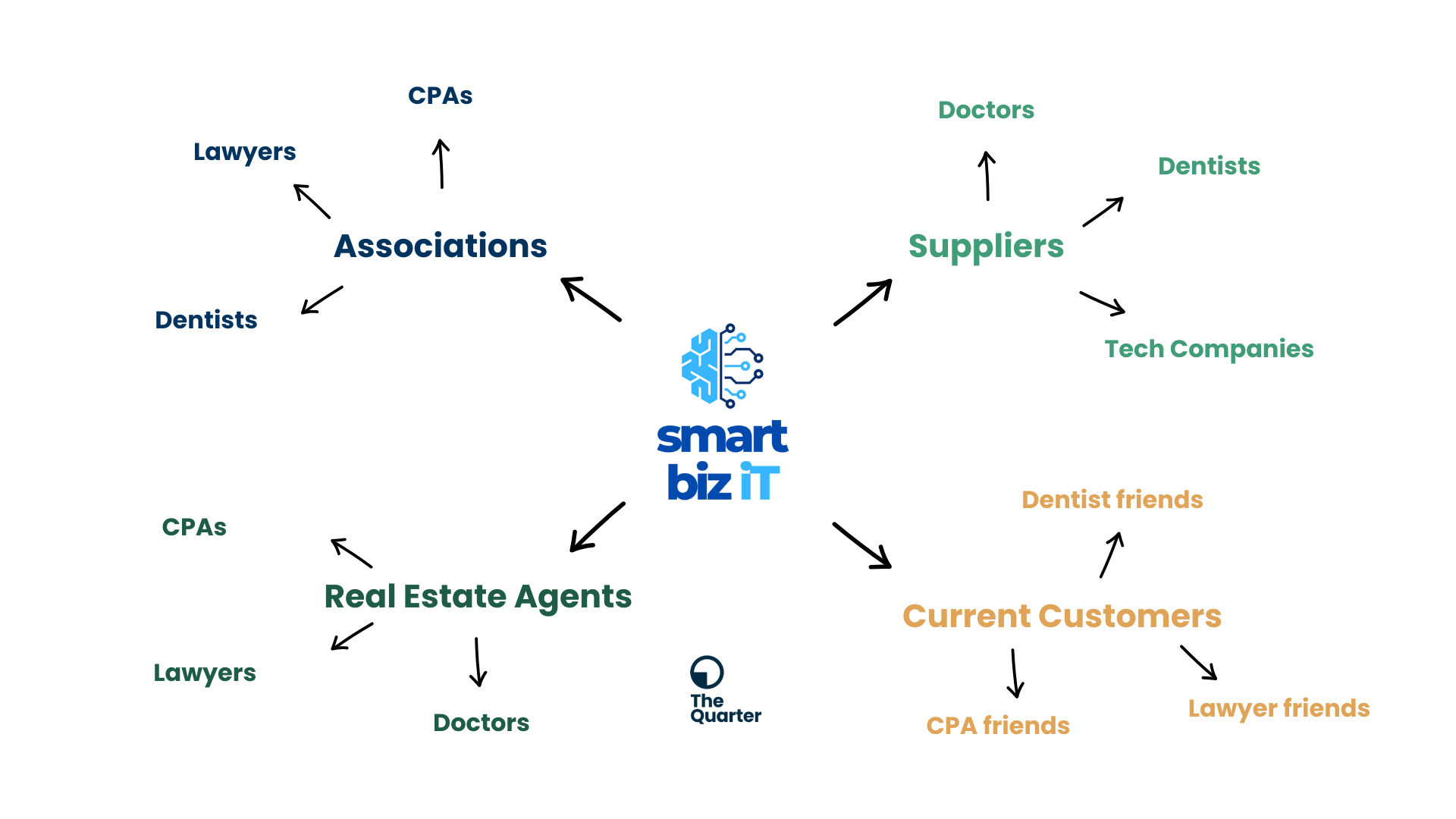
Within these revenue strategies, I'd run three experiments. In this order.
1. Go to a niche conference for one of your customer profiles.
Not a general business or tech conference. A dental industry conference. A conference for accountants. A conference for lawyers. Something where Shawn's ideal customer is the entire room.
Look for smaller ones, around 200 people or less. The conversations are easier to have. And if Shawn already has a customer who's going, even better. Show up together. Let that customer make introductions. The pitch stays the same the entire conference because everyone in the room has the same problem.
If it doesn't generate any business, try one more. If that doesn't work either, move on.
2. Have 10 conversations with potential partners.
Suppliers, business banks, commercial real estate agents, CPA associations. People who are already working with Shawn's ideal customer and could be sending him referrals.
The goal is simple: can he convert any of those 10 conversations into an actual referral partnership? If he can't get a single one, scrap it. But my gut says this one works.
3. Build one case study.
Pick a client who loves Smart Biz iT. Interview them, get their quotes, understand their story. Then use that case study the next time Shawn sends a proposal to a similar client and see if it helps close the deal faster.
This one is last because it's also the most outsourceable once revenue picks up. But it's still worth running the experiment now.
Shawn has built something real with Smart Biz iT. The expertise is there, the early customers are there, and the market is big. The main thing holding him back isn't the service, it's focus. Narrowing down to the right customer, building the right partnerships, and letting those two things compound over time is how Smart Biz iT gets to $250k. The experiments above are where I'd start.