He Built One Business on the Fly, The Next on Purpose


Shaun Lee has helped run one of the largest homeless shelters in the country, started a mobile farmers market, and now owns a leadership consulting firm. Not exactly a straight line.
But there's a thread running through all of it and it's the reason his second business looks nothing like his first.
That first business, a local-food company called Truckin' Tomato, hit a $1 million run rate in about six months. Then Shaun sold it, uprooted his family for the promise of a simpler life, and ended up walking his neighborhood at night, asking himself what he was going to do next.
His second business, 6 Levers, he built to be the opposite: profitable from day one, and designed so it would never take over his life the way the first one did.
In this deep dive, we'll get into how a social worker ended up building two very different companies, why he walked away from the one that was working, and how he's building this one so it doesn't depend on him at all.
Let's dive in.
Before the businesses
Shaun started as a social worker in St. Louis, working with people experiencing homelessness. He got his BSW and MSW, and even taught as an adjunct professor in his mid-twenties. What pulled him in wasn't just helping individuals, it was the systems. He wanted to understand how you solve big social problems at scale.
That systems instinct shows up everywhere in his career. At Catholic Charities he started as a case manager helping people living on the streets find housing, then led a team that relocated about 300 families from New Orleans to St. Louis after Hurricane Katrina.
From there he helped open Haven for Hope in San Antonio, which went on to become the largest residential facility for homelessness in the US, with around 1,500 people sleeping there on any given night. He worked his way up to COO.
He was being groomed to become CEO, but the organization was honest with him: he didn't have the business training yet. So he went and got his MBA. What he didn't expect was that the MBA would give him the entrepreneurial bug and pull him in a completely different direction.
Around the same time, homelessness was becoming a heavily political issue, and that wore on him. He still cares deeply about it and does hands-on volunteer work today, but he lost interest in fighting it as a career.
The story of Truckin' Tomato
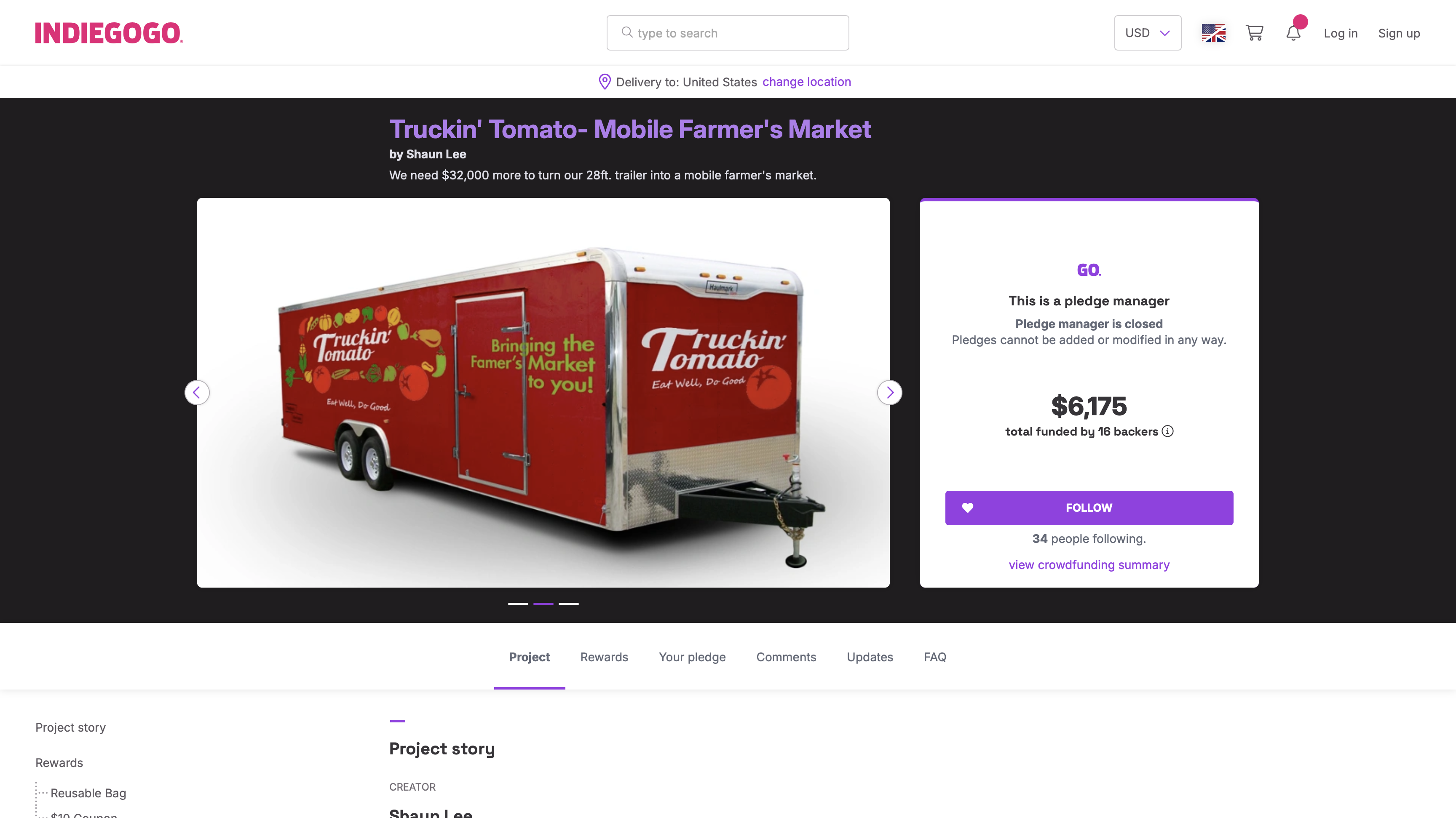
Shaun's MBA capstone was to start a business. His team landed on a wacky idea: a mobile farmers market, basically a food truck crossed with a farmers market. When it came time to actually build it, Shaun was the only one crazy enough to do it for real. He found a backer in San Antonio, left his role at Haven for Hope, and started Truckin' Tomato.
The original idea was to make the farmers market experience more accessible. They'd bring local food to big businesses in San Antonio so people could shop on their lunch hour. It was novel enough that it caught national attention, with people calling Shaun to ask how he was pulling it off.
There was just one problem. It wasn't a profitable business.
So Shaun did what most entrepreneurs do. He pivoted. First to home delivery, taking the same great local food and dropping it at people's doors. Then, almost as a side experiment, he started delivering to a handful of restaurants that already wanted to source locally but were struggling to do it well.
That experiment landed three or four accounts fast, and the numbers told the story. Wholesale was far more predictable on both ordering and revenue. So Shaun shut down the other two parts of the business and went all in on wholesale delivery to hotels, restaurants, and micro-grocers.
The real value was never the food truck or the delivery vans. It was the supply chain. Shaun had built something genuinely rare, and he found a niche inside it. There's a whole tier of what he thought of as medium-sized farms, the ones too big to just sell at a farmers market but too small to supply a big-box grocer that wants 20 stores served at once. Those farms needed a real outlet, and Shaun gave them one.
There was only one other group in central Texas doing wholesale like this. They had a solid supply chain but a reputation for cold, low-touch service. So Shaun leaned the other way and combined a unique local supply chain with a warm, high-touch, relational experience. That was the differentiator.
It worked. Truckin' Tomato went from making $200,000 to $300,000 a year to a $1 million run rate in about six months. Once a few well-known San Antonio establishments vouched for him, the referrals compounded, and the business scaled toward $1 to $3 million as it expanded into Austin.
Here's the catch, and it's the part that matters for the rest of the story. This kind of business is brutally capital-intensive. To grow, you need cold storage, freezers, refrigeration, and trucks. By the time Shaun was bumping against the limits of his storage space, he owned about 85% of the company, was carrying most of the risk personally, and still hadn't returned to the salary he'd made as a COO five years earlier.
The business was doing okay. But it was hitting limits on both ends, the room it had left to grow and the room Shaun had left to give it.
Walking away from what he built
The exit came out of nowhere.
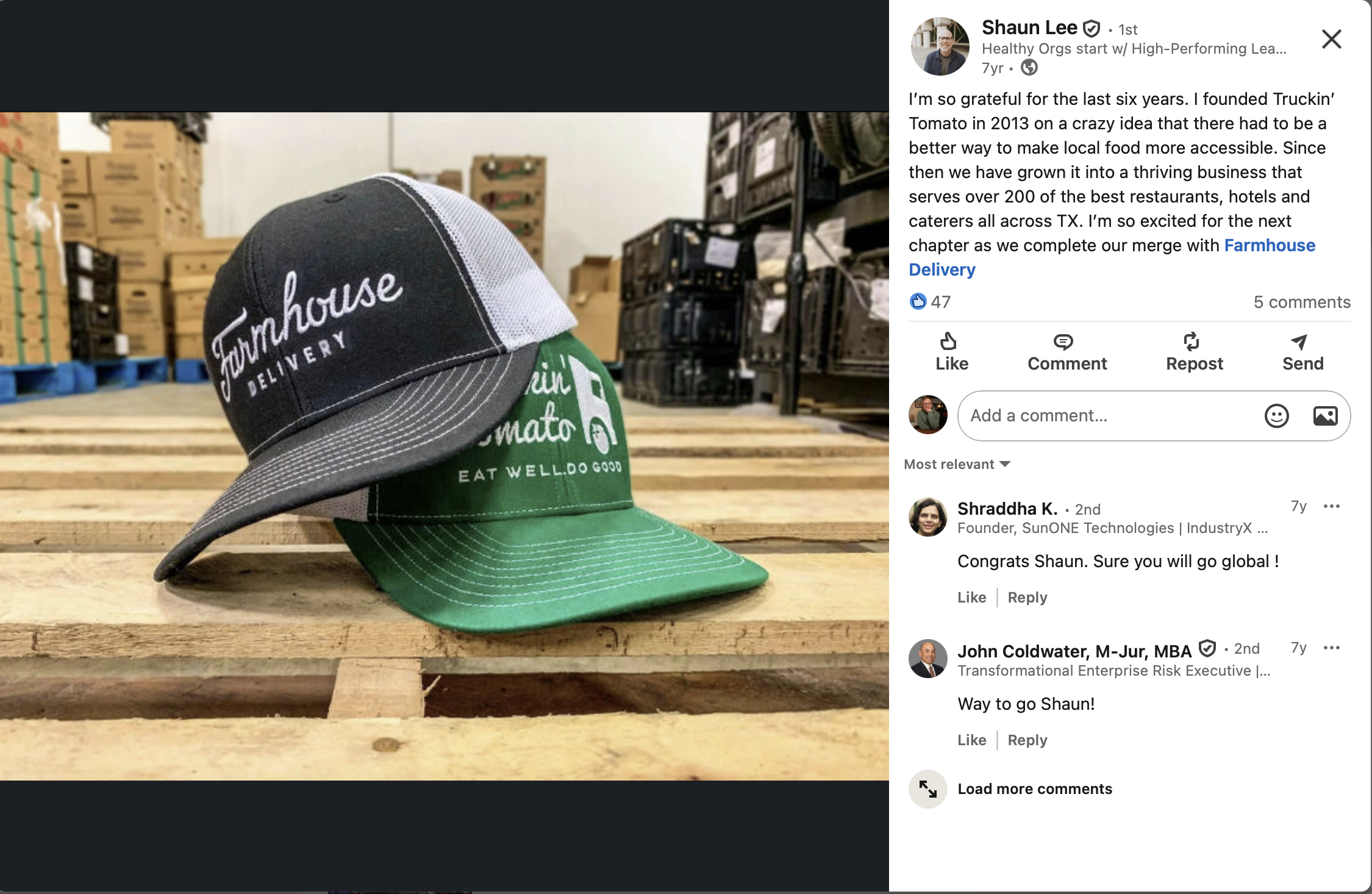
Shaun's one person in Austin, Ashton, happened to be connected to an investor who had just put money into an aquaponic farm, was about to buy the hydroponic grow-tower company Lettuce Grow, and was looking at acquiring an Austin company called Farmhouse Delivery. When he heard about Truckin' Tomato, he realized the two businesses ran on nearly the same supply chain and could fit together.
Shaun wasn't trying to sell. But once the idea was on the table, he stepped back and looked at his actual life. He'd been grinding hard, his kids were young, and he still hadn't matched his old COO salary. As a person of faith, he prayed through it. And it started to feel like the right thing to do.
The merger was exciting on paper. His 20 employees plus Farmhouse's 60 would become an 80-person company, and he was asked to oversee joining the two. So he moved his family to Austin to do it.
Then came the part he's refreshingly honest about. He'd sold the company hoping for a simpler, less stressful life, and that's not what he got. His vision and the new owners' vision weren't aligned, and he slowly lost interest. One night he went out walking around his neighborhood, praying, asking himself what he was going to do, because it just didn't feel right.
What he needed next wasn't another company to run. It was space to figure out what came next.
The story of 6 Levers
The reset started with a conversation.
Shaun reconnected with his friend Josh Aranda, who owned a consulting group called Mission Matters Group. At the time they were doing technology and Salesforce consulting for nonprofits, but in that work they kept running into something bigger: broad organizational dysfunction. Josh's pitch was simple. Come build something around organizational health and leadership development inside our company. Build a company within a company.
Saying yes gave Shaun something he didn't know he needed: about three years where he wasn't the owner. Josh gave him plenty of freedom, and Shaun got to build something and lead people without carrying payroll or the weight of the whole business on his back. That was the reset that eventually made him ready to build again.
In the early days they leaned on other people's frameworks: OKRs, planning sprints, Patrick Lencioni's team-building work, and the EOS system from the book Traction.
But the more they practiced them, the more their own opinions stacked up. They kept hitting what Shaun calls "too many rubs" between those frameworks and what they believed to be true about human behavior. Eventually they realized they'd built something of their own. That became the 6 Levers framework.
They incubated 6 Levers inside Mission Matters Group for about a year and a half, then spun it out as its own company at the end of 2023, with three owners: Shaun, his business partner Joe Olwig in St. Louis, and Mission Matters Group.
This time, Shaun built differently. Truckin' Tomato had taught him how fragile a business could be. It ran thin on cash, it needed heavy infrastructure just to grow, and a single bad weather day could wreck a whole week.
So 6 Levers was designed to be profitable from day one.
On the fly, then on purpose

Put Shaun's two companies side by side and the difference isn't the product. Both sold something real. The difference is how he built them.
Truckin' Tomato was built on the fly. He learned as he went, made plenty of mistakes, and grew a business that demanded more capital, more risk, and more of him the bigger it got. 6 Levers was built on purpose, profitable from the start, and designed so growth doesn't automatically mean more strain.
Part of that is how Shaun thinks about risk. He'll tell you he's fairly risk averse, and he means it. He doesn't like being over-leveraged, and he won't take on more than he's comfortable carrying. That sounds like the opposite of a founder, but it tracks with a lot of the best builders I've been around. They aren't reckless. They build the foundation first, then take the calculated shot.
The other part is that Shaun built 6 Levers so it doesn't depend on him. That's harder than it sounds, because 6 Levers is a consulting business, and consulting usually lives or dies on the people doing the work.
As Shaun put it, if every project feels new and unique, it's really hard to grow. A solo consultant can do great, meaningful work that way for a long time, but if you're trying to grow a business, you have to productize.
So instead of selling Shaun's time, 6 Levers sells repeatable products built on the framework. One is a four-month executive team transformation program. The other is a five-session leadership course called Leading With Intention, focused on the relational side of leading, or as Shaun frames it, how to be the kind of boss people remember because you actually cared about them, developed them, and gave them real feedback.
There's a public version of the course anyone can join, plus a private cohort for bigger companies sending 25 or more people through at once.
If that sounds familiar, it's the same move Allea Grummert made with Duett, packaging her email marketing work into one clear productized service instead of writing a custom proposal for every client.
Right now, the business still leans on Shaun's personal network. A lot of the early clients came because they trusted him, not the offering. So the goal now is to gradually move that trust from the founder to the products. As he told me, they don't actually want clients hiring them because they know Shaun and Joe. They want clients coming for the proven products.
The first business ended up owning him. This one is built so it doesn't depend on anyone, including him.
Growth strategies of 6 Levers
6 Levers is on a different trajectory than a lot of the businesses I cover, mostly because of deal size. Their deals run between $20,000 and $80,000, which means closing just four or five clears $250,000. They hit a $250,000 run rate in about six months and have since crossed $1 million in annual revenue, with a lean team of four: Shaun, Joe, a senior consultant, and an operations director. Here are the strategies actually driving that.
Speaking and workshops. This is the single biggest generator of new business. Shaun and Joe speak and lead workshops all over the country, and along the way they stumbled into an accidental niche: organizations that serve people with intellectual and developmental disabilities, including affiliates of groups like Easterseals, United Cerebral Palsy, and The Arc. They work across all industries, but that niche currently brings in the most new business.
Network and referrals. The first clients came from a place Shaun had spent decades building: his own network. Back when he was COO at Haven for Hope, he'd had 10 direct reports, and 7 of them went on to run their own organizations. They were the first people he called. Five of them hired him. In the early days, 80 to 90% of the business came through his own network, and referrals from those first relationships still do a lot of the heavy lifting.
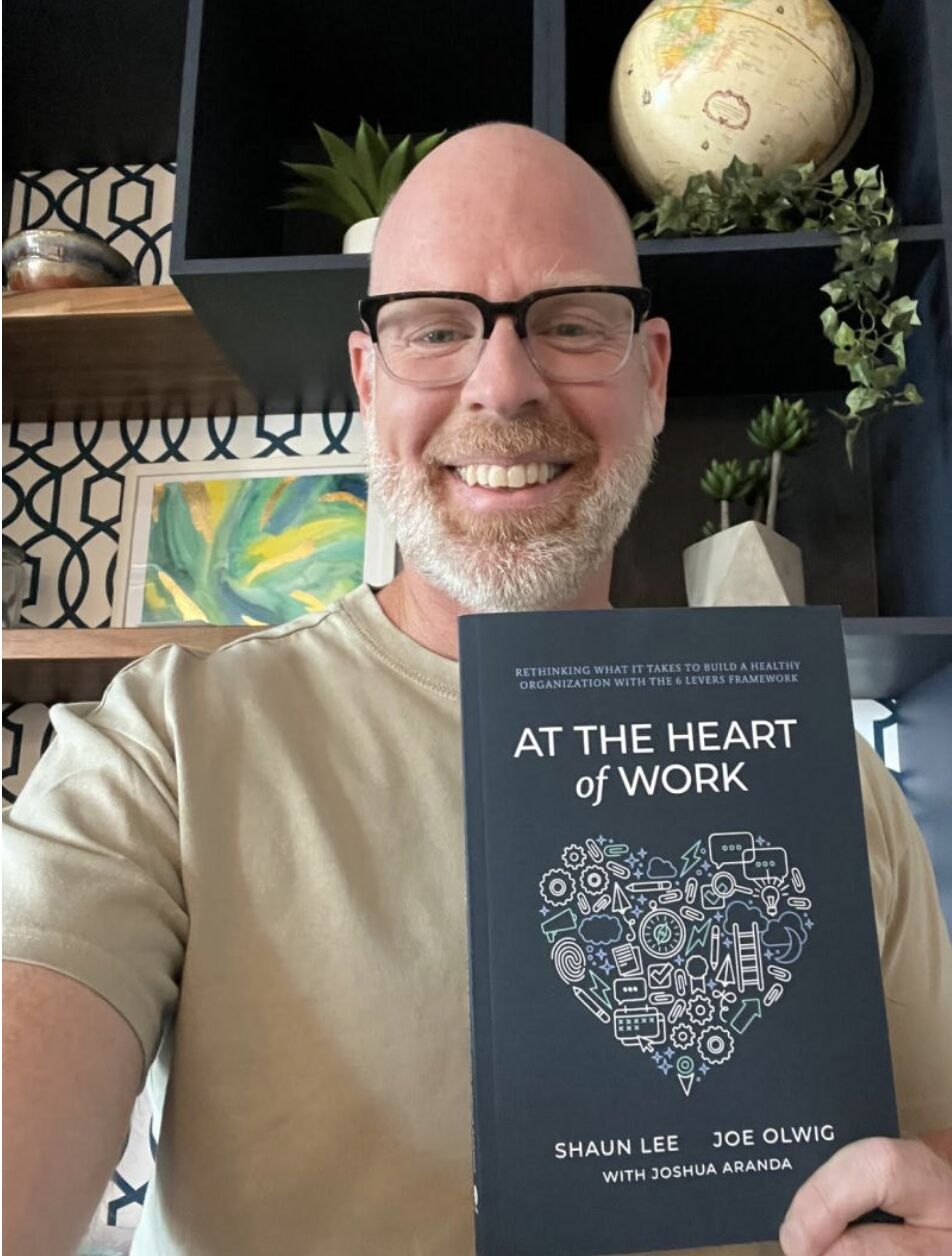
Newsletter and the book. Shaun writes two to three hours a week for the 6 Levers newsletter, which is actually how he and I connected. It's still early, but the feedback has been strong. The team also wrote a book, At the Heart of Work, that lays out the framework.